By admin
We take for granted the ability to pinpoint a location on Earth with pinpoint accuracy. Whether navigating across oceans, coordinating rescue operations, or simply finding a friend in a crowded city, our modern world relies heavily on a globally understood system of spatial reference. At the heart of this system lies the humble map, often adorned with a network of lines known as latitude and longitude. These seemingly simple lines are far more than decorative features; they represent a sophisticated and elegant framework for defining and communicating geographical position. This article delves into the intricacies of latitude and longitude, exploring their historical development, practical applications, and the underlying mathematical principles that make them such a powerful tool.
A Brief History of Spatial Understanding:
The concept of representing the Earth’s surface on a flat plane has been around for millennia. Early maps were often crude and subjective, reflecting the cartographer’s limited knowledge and cultural biases. However, the need for more accurate and consistent mapping grew alongside expanding trade routes, military campaigns, and scientific exploration.
Ancient Greek scholars, particularly Eratosthenes and Ptolemy, laid the groundwork for modern coordinate systems. Eratosthenes, in the 3rd century BC, famously calculated the circumference of the Earth with remarkable accuracy, demonstrating an understanding of its spherical shape. Ptolemy, in his 2nd-century AD Geography, attempted to create a comprehensive world map using a grid system of latitude and longitude. While Ptolemy’s maps contained significant errors due to limited data and reliance on estimations, his work provided a crucial framework for future cartographers.
The development of accurate timekeeping was crucial for refining longitude measurements. Before the invention of reliable marine chronometers in the 18th century, determining longitude at sea was a significant challenge. Sailors relied on celestial observations and dead reckoning, methods prone to significant error. The invention of the chronometer by John Harrison revolutionized navigation, allowing sailors to accurately determine their longitude by comparing local time with the time at a known reference point (usually Greenwich).
Understanding Latitude: Measuring Distance North and South:
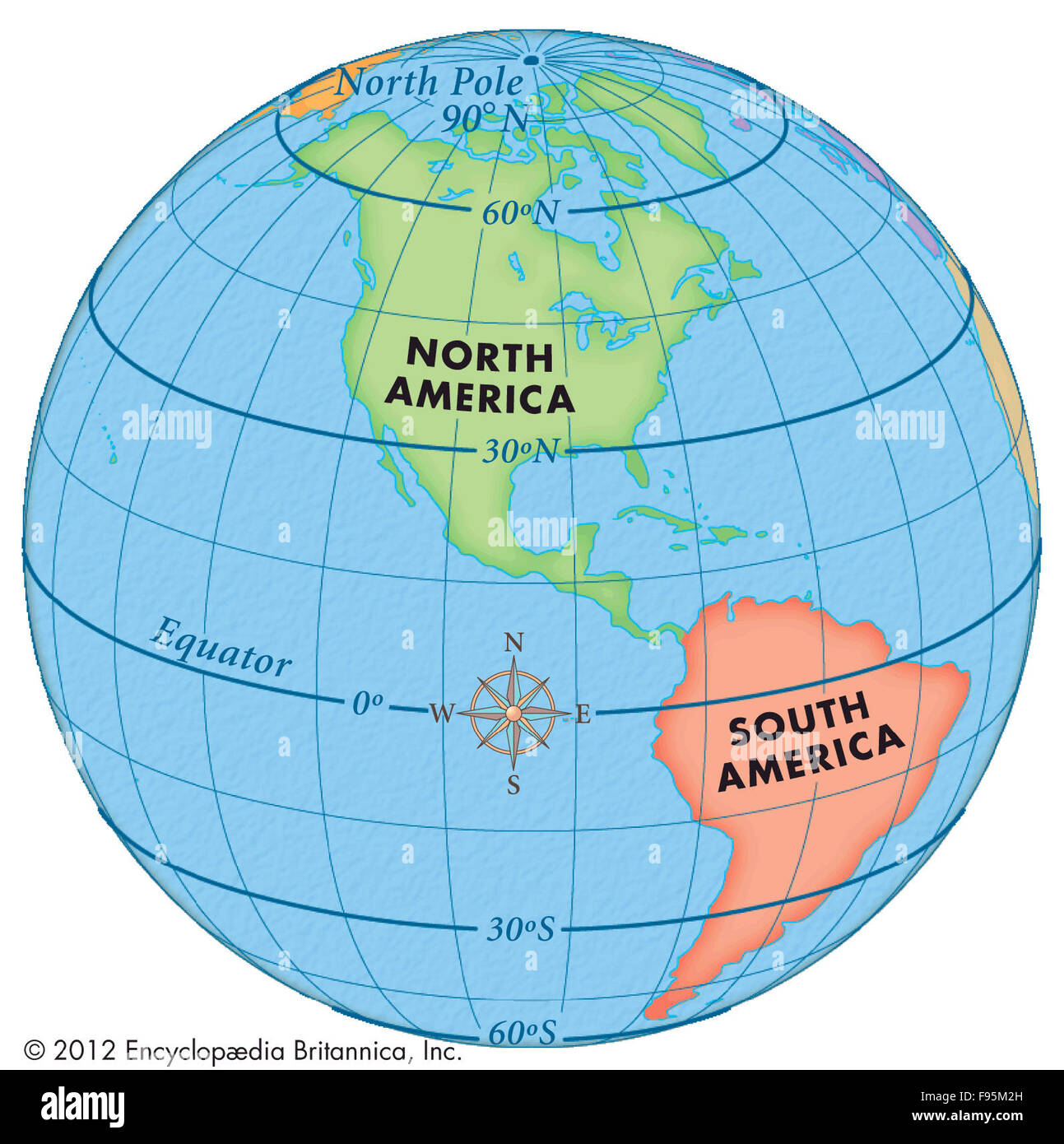
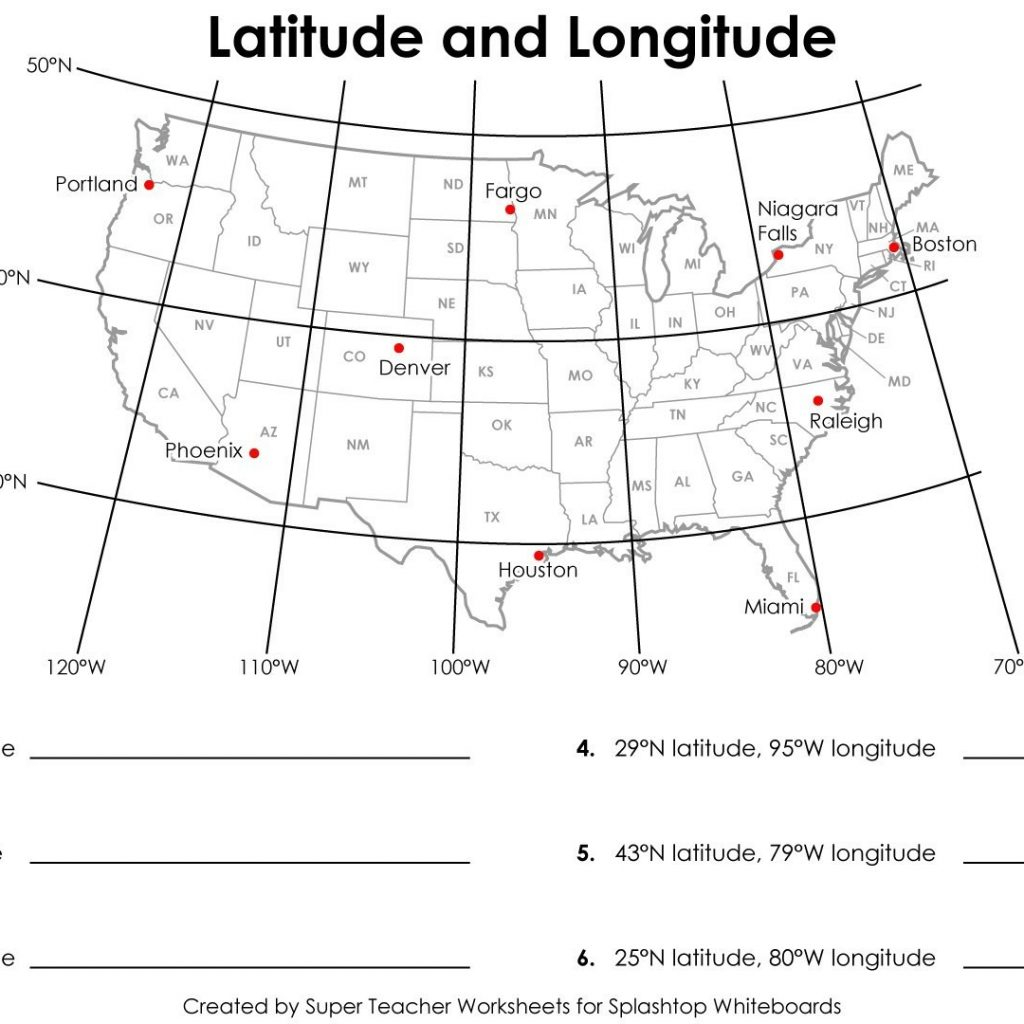
Latitude, often represented by the Greek letter phi (φ), measures the angular distance of a point on Earth north or south of the Equator. The Equator itself is assigned a latitude of 0 degrees. Latitude lines, also known as parallels, are imaginary circles that run east-west, parallel to the Equator.
The Earth’s rotation axis provides a natural reference point for defining latitude. The North Pole is assigned a latitude of 90 degrees North (90°N), while the South Pole is assigned a latitude of 90 degrees South (90°S). All other latitudes fall between these extremes.
Each degree of latitude is approximately 69 miles (111 kilometers). This distance is relatively consistent, although it varies slightly due to the Earth’s slightly oblate shape (i.e., it’s not a perfect sphere). Degrees of latitude are further subdivided into minutes and seconds. One degree equals 60 minutes (‘), and one minute equals 60 seconds ("). Therefore, a precise latitude coordinate might be expressed as 34° 03’ 04" N, representing 34 degrees, 3 minutes, and 4 seconds north of the Equator.
Latitude plays a significant role in determining climate and vegetation patterns. Regions closer to the Equator receive more direct sunlight and tend to have warmer climates, while regions closer to the poles receive less direct sunlight and tend to have colder climates. Latitude also influences the length of day and night, with areas near the poles experiencing extreme variations in daylight hours throughout the year.
Understanding Longitude: Measuring Distance East and West:
Longitude, often represented by the Greek letter lambda (λ), measures the angular distance of a point on Earth east or west of the Prime Meridian. Unlike latitude, which has a natural starting point at the Equator, the choice of a Prime Meridian was historically arbitrary.
For centuries, various nations used their own prime meridians, often passing through their capital cities or major observatories. This lack of standardization created confusion and hampered international cooperation. In 1884, an international conference in Washington, D.C., established the Greenwich Meridian as the Prime Meridian, passing through the Royal Observatory in Greenwich, England.
The Prime Meridian is assigned a longitude of 0 degrees. Longitude lines, also known as meridians, are imaginary lines that run north-south, converging at the North and South Poles. Longitude values range from 0 degrees to 180 degrees East (180°E) and 0 degrees to 180 degrees West (180°W). The International Date Line, located roughly along the 180th meridian, marks the boundary where the date changes.
Unlike latitude, the distance represented by one degree of longitude varies depending on the latitude. At the Equator, one degree of longitude is approximately 69 miles (111 kilometers), similar to the distance represented by one degree of latitude. However, as you move towards the poles, the distance represented by one degree of longitude decreases, eventually converging to zero at the North and South Poles. This convergence is due to the meridians converging at the poles.
Longitude is crucial for determining time zones. The Earth rotates 360 degrees in 24 hours, meaning that each 15 degrees of longitude corresponds to a one-hour difference in local time. This principle is used to establish standard time zones around the world, although the boundaries of time zones are often adjusted to align with political or geographical boundaries.
Practical Applications of Latitude and Longitude:
The latitude and longitude coordinate system is indispensable for a wide range of applications, including:
- Navigation: Sailors, pilots, and even hikers rely on latitude and longitude to determine their position and navigate to their destination. GPS (Global Positioning System) technology uses satellites to determine precise latitude and longitude coordinates, enabling accurate navigation in real-time.
- Mapping and Cartography: Latitude and longitude provide the foundation for creating accurate and consistent maps. Cartographers use these coordinates to project the Earth’s surface onto a flat plane, creating maps that can be used for a variety of purposes, including navigation, urban planning, and environmental monitoring.
- Geographic Information Systems (GIS): GIS software uses latitude and longitude to store and analyze spatial data. This allows users to create maps, analyze spatial patterns, and make informed decisions based on geographical information.
- Search and Rescue Operations: In emergency situations, latitude and longitude coordinates can be used to pinpoint the location of individuals in distress. This information is crucial for coordinating search and rescue efforts and ensuring timely assistance.
- Land Surveying: Surveyors use latitude and longitude to accurately define property boundaries and create land surveys. This information is essential for legal and real estate purposes.
- Scientific Research: Scientists use latitude and longitude to study a wide range of phenomena, including climate change, biodiversity, and geological processes. By tracking changes in latitude and longitude over time, researchers can gain insights into the dynamics of the Earth system.
The Digital Age and the Evolution of Spatial Referencing:
The advent of digital technologies has revolutionized the way we use and interact with latitude and longitude. GPS technology has made it easier than ever to determine our location with pinpoint accuracy. Online mapping services, such as Google Maps and OpenStreetMap, provide access to detailed maps and spatial data for virtually any location on Earth.
Furthermore, new spatial referencing systems are emerging that build upon the foundation of latitude and longitude. These systems often incorporate additional information, such as elevation and time, to provide even more precise and comprehensive spatial data.
Conclusion: A Timeless Framework for Understanding Our World:
Latitude and longitude, despite their simplicity, represent a profound achievement in human understanding of the Earth. They provide a timeless and universally understood framework for defining and communicating geographical position. From ancient mariners navigating by the stars to modern-day scientists studying climate change, latitude and longitude have played a crucial role in shaping our understanding of the world around us. As technology continues to evolve, the importance of these fundamental coordinates will only continue to grow, serving as the unseen grid that connects us all. They are a testament to the power of human ingenuity and the enduring quest to map and understand our planet.